Rocket Auto | Product & Engagement Strategy

An existing customer relationship. A major purchase opportunity.

At a glance

Challenge
By mid-2021, Rocket serviced mortgages for about 2.4 million clients. We set out to build a car-buying marketplace that could earn similar trust while relying on a partner platform for key functions.
My role
I led product and engagement strategy with Taj Makki on research and Todd Ridley on design. Together, we set priorities, shaped the first launch, and navigated trade-offs with Product and Engineering.
The launch
Rocket Auto went nationwide in August 2021, offering over 35,000 used vehicles from more than 300 dealers. Shoppers could compare cars online and get help from a Rocket Auto advisor.

Buying or refinancing a home often means bigger changes such as moving, a new job, growing a family, or needing a different car. We saw these moments as deeply connected, and that pattern became our starting point.

Auto lending research gave us a reason to explore that connection. In one study, 22% of prime-or-better consumers who inquired about a mortgage opened an auto loan within 12 months, compared with 11% of consumers overall.

Rocket’s background in mortgages and consumer financing gave us a foundation. We saw an opportunity to bring vehicle shopping, trusted advice, and partner offers together in one seamless place.

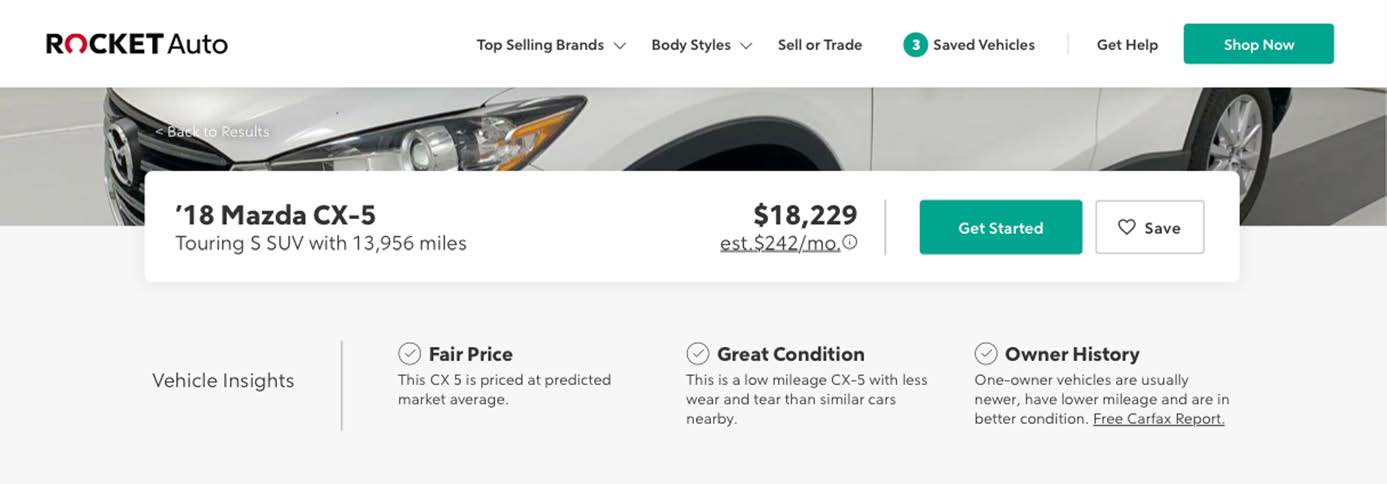
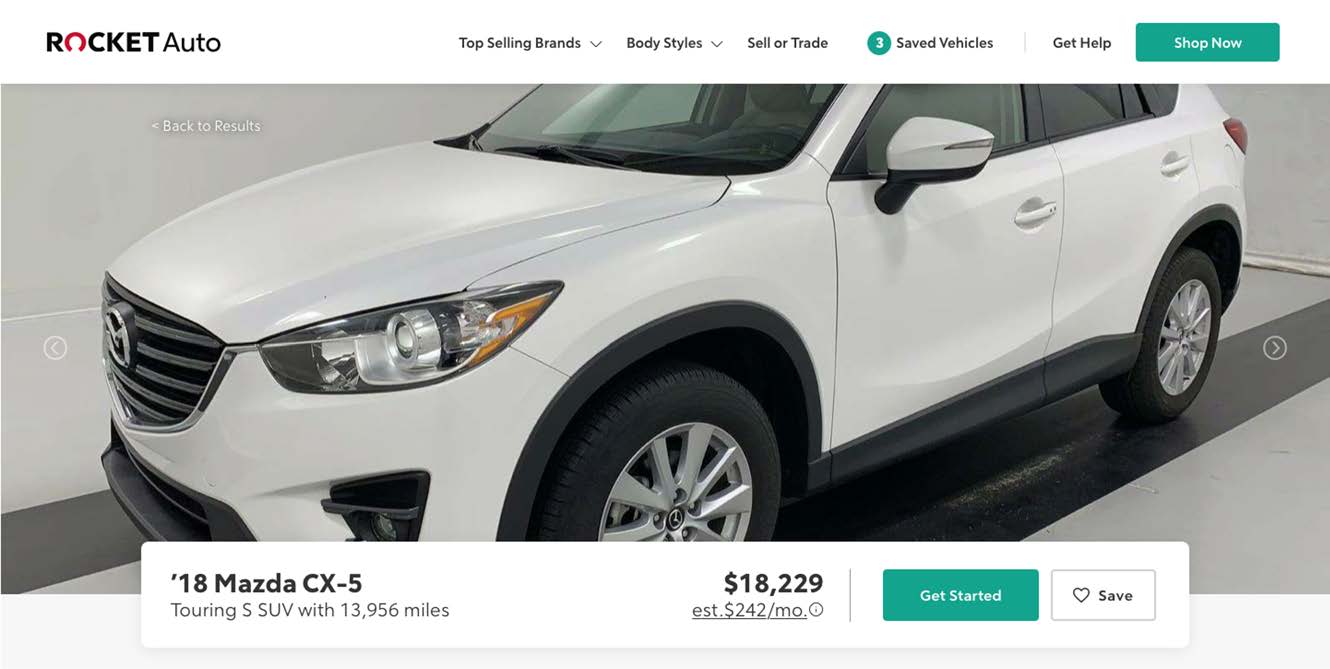
The desktop header brings the vehicle, price, estimated payment and actions into view.
The desktop header shows the vehicle, price, estimated payment, and actions all together.
01

Anchor the business model in a visionary experience strategy.

We blended a consumer marketplace with a service team so buyers could get support with sales, financing, and contracts. Our first brief explored two tracks: one focused on giving agents the right information and tools, the other on helping shoppers take charge as the marketplace handled more of the buying journey.

We paid attention to when a car might come up naturally in the Rocket experience: a new commute, a move, or a conversation about refinancing. Those life events became our cue to offer timely, relevant support. By embedding the car-buying experience within our client relationships, we aimed to help people when it mattered most. We encouraged clients to explore vehicles and compare them before sharing any personal information. The aim was to make it easier to compare vehicles and give shoppers a reason to trust the service. We kept asking ourselves: what value does a shopper actually receive before sharing details?
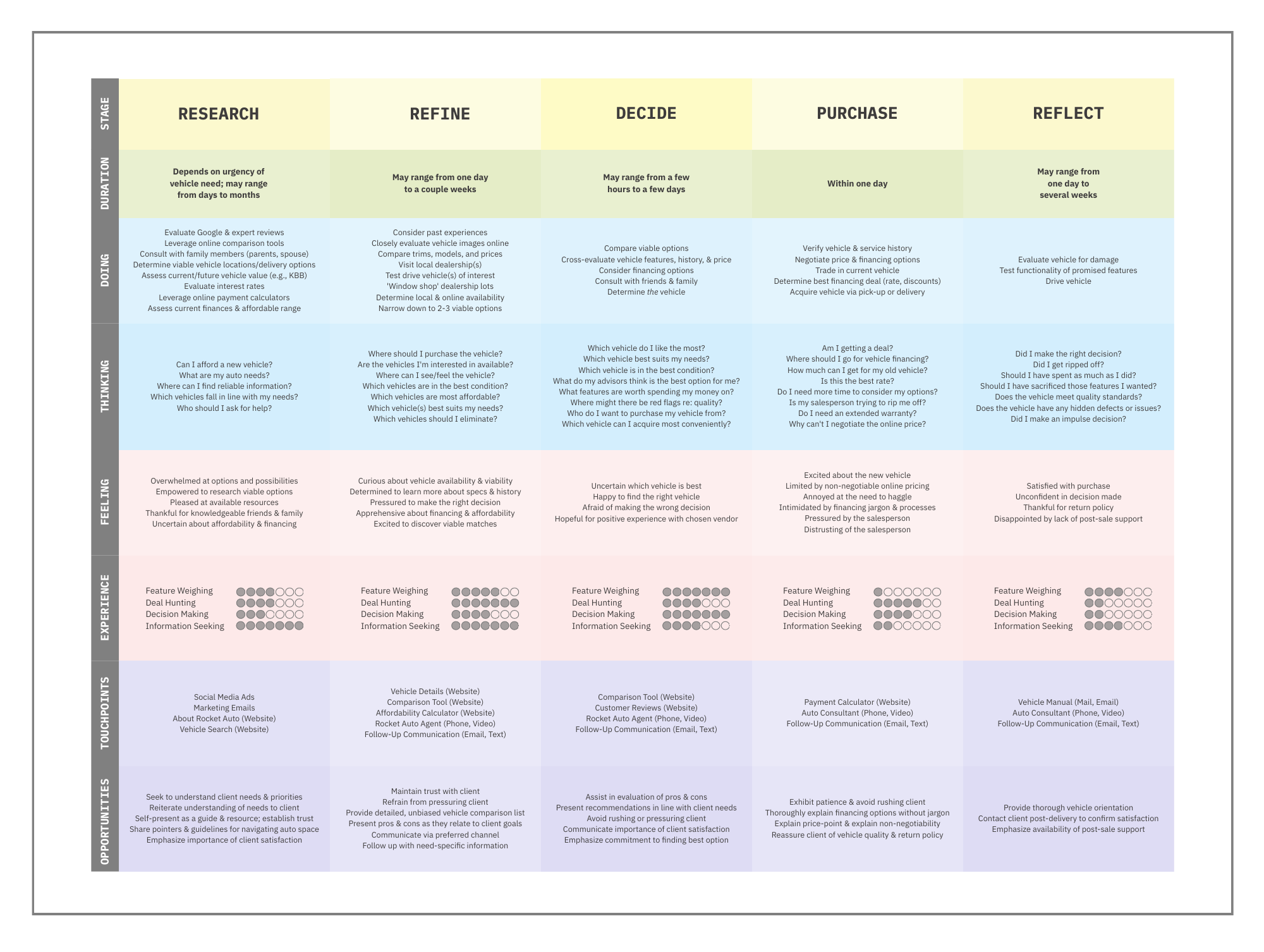
Five buying stages: Research, Decide, Purchase, Receive and Reflect.
The journey connected buying stages with customer questions, service opportunities, and the support needed at each step.
02

Leverage rigorous research to drive confident decisions.

Taj led the usability study, following 30 active car shoppers across six services. We brought what we learned into our product priorities and leadership discussions. Four key insights stood out.

Price and mileage needed to be visible while people compared vehicles; repeated trips between results and detail pages made comparison harder.

Payment tools needed to explain their assumptions. People still had questions about interest, taxes, fees, and the final cost after using a calculator.

Vehicle condition, history, and useful photography helped people assess what they were buying.

Clear explanations of the buying and delivery process helped people understand what would happen next.

Only one shopper tried a form that asked for personal information, and they used made-up details. That finding shaped what we wanted Rocket Auto to offer up front. Shoppers could compare cars, see the price, and understand how the payment estimate was calculated. When shoppers needed help, they could bring a vehicle or a specific question to the conversation.

Taj and Jenny Lee’s research on agent support showed what buyers valued once they reached out. They wanted knowledgeable, patient guidance in plain language and time to make their own decisions.

I planned a working session to identify the biggest problems, define the key tasks, and vote on priorities. Those priorities would inform design and development stories.

Thirty active vehicle shoppers, evenly distributed by age and gender, compared six services through shopping, selection and affordability tasks.
The usability study shows where buyers lost time or confidence while comparing cars and estimating costs.
Clients feel in control through knowledgeable guidance, time and space for decisions, and a transparent process with clear expectations.
The agent research shows what buyers wanted from a conversation once they were ready to ask for help.
03

Transform opportunities into scalable, high-impact initiatives.

Todd Ridley, Rocket Auto’s design lead, suggested reordering the work. Together with Todd and a Product Strategy colleague, we brought design, prototyping, and product management into the process earlier. This helped us spot where outside support could relieve pressure on the team.

We defined the alpha and the first release around immediate support, next-phase recommendations, and the key people needed to keep things moving. Scoping the first phase meant looking at the market, critical use cases, and a service blueprint. The next phase would focus on developing and testing flows and tools.

Salesforce became an early test of that sequencing. We asked whether the first engagement could include integration. Steve Cusumano recommended starting with the agent’s existing workflow and its limits. That raised a critical question for the team: what would an agent need to pick up where the shopper left off?

Proposed buyer-to-agent handoff

  1. ShopperReviews vehicles and asks for help.
  2. Rocket Auto agentReceives the request, checks relevant information, and uses prompts to guide the conversation.
  3. DealerThe agent guides the buyer to a dealer to complete the purchase.
We scoped the handoff so agents could pick up a request, find relevant information, and use prompts to guide buyers to dealers.
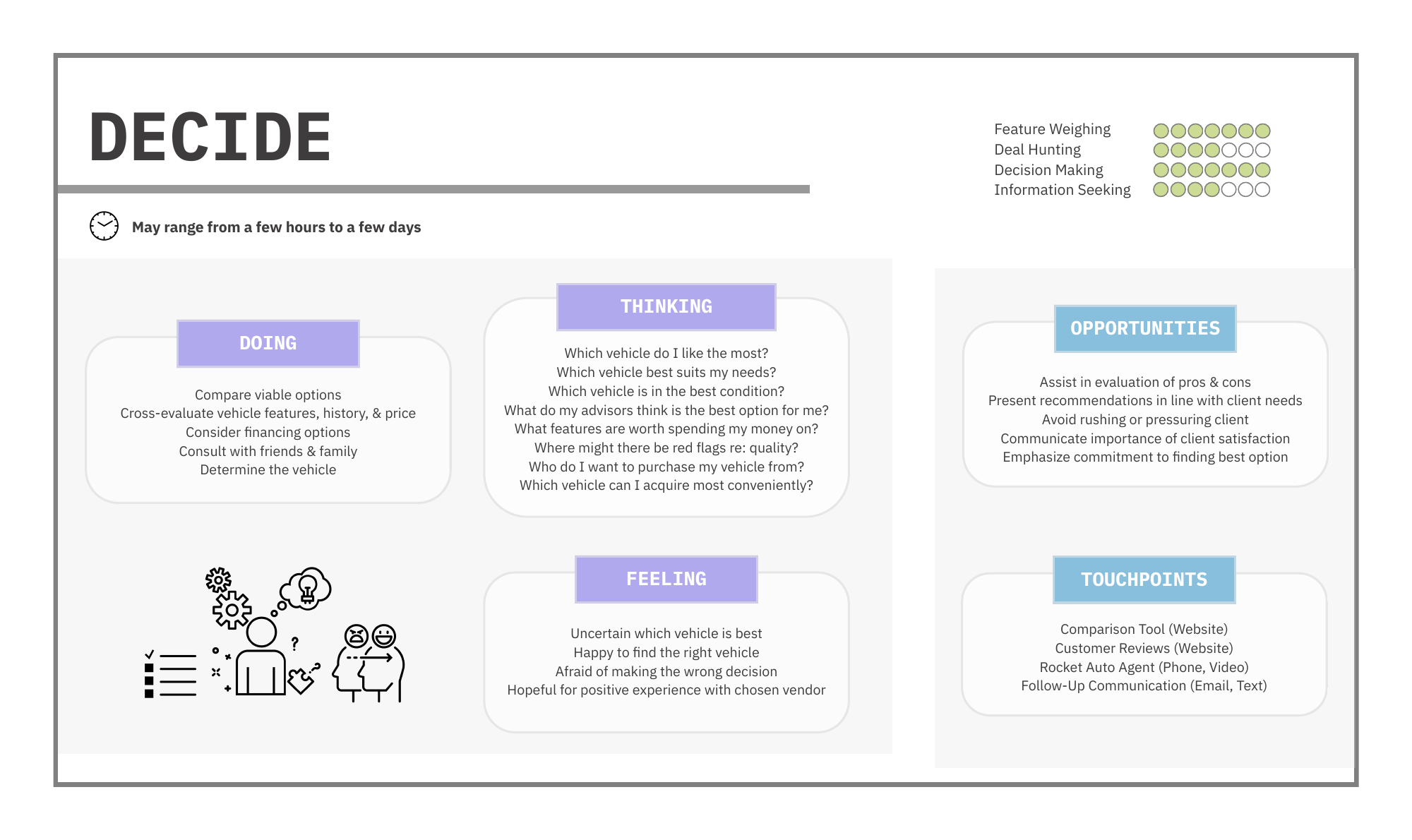
The Decide stage maps buyer questions, emotions, support and service opportunities.
The team’s journey map connected buyers’ decision needs with comparison tools, reviews, agent guidance, and follow-up support.
04

Safeguard the end-to-end experience.

Todd raised a concern about letting the platform partner control the interface and technology. The partner’s interface could affect how shoppers compared cars, understood pricing and delivery, and reached a Rocket advisor. We explored API integrations so Rocket could manage those decisions within its own interface while the partner ran its platform. That would let us keep the shopping experience consistent for Rocket clients.

For the first release, the team finished Spark design review and used CSS to align the interface visually. Direct integration with Spark’s component code was added to the post-MVP backlog. This let us use Rocket’s design in the first release while engineering worked through the bigger platform dependencies.

I raised a concern about consent. If customer data moved between Rocket businesses, how would customers understand and manage that choice? We needed to account for customer permissions while the broader data infrastructure was still in development.

05

Design the final interface to be clear and intuitive.

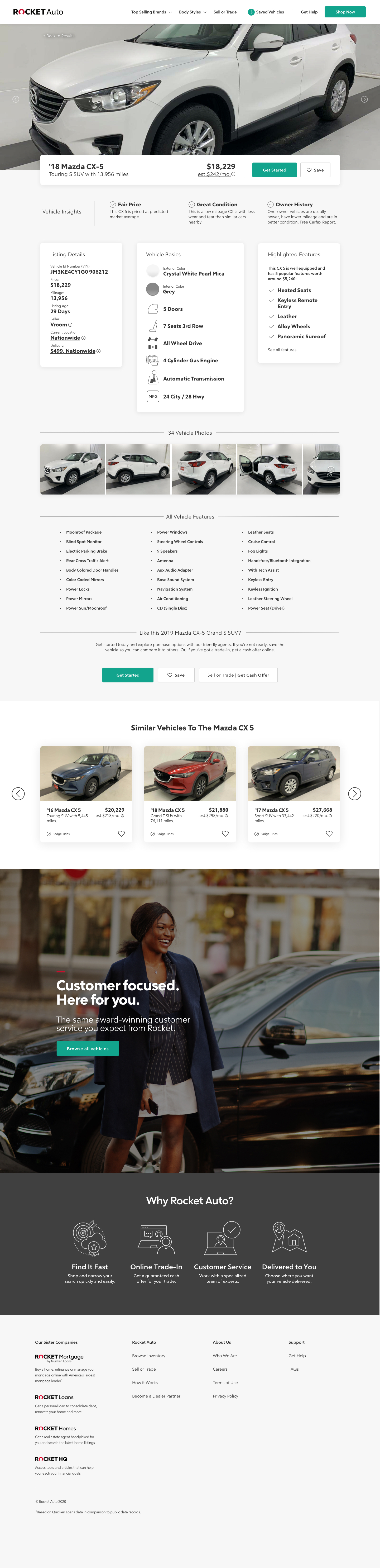
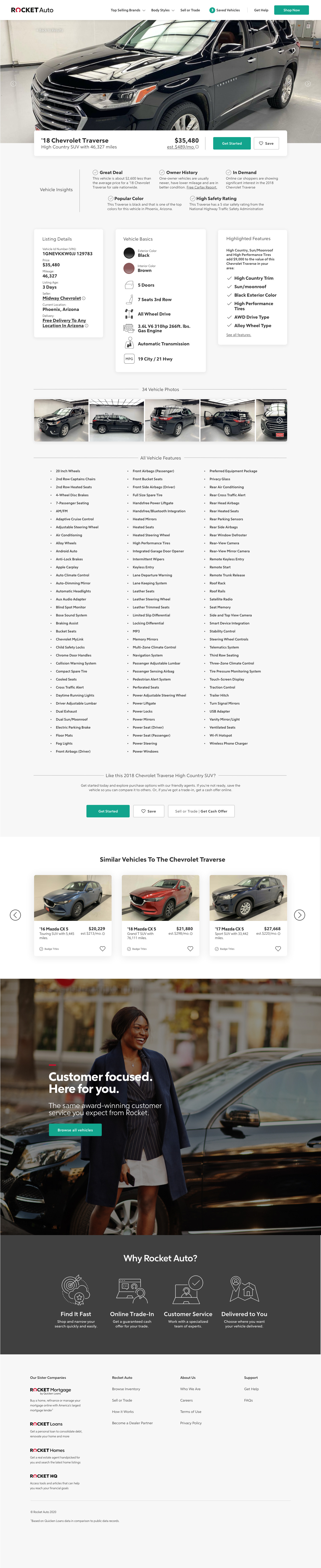
The team’s vehicle-detail design grouped the price and estimated payment with the car’s condition, history, and photos. We placed seller and delivery information next to the listing so buyers could see who would handle the sale and what delivery would involve. These choices directly answered the questions we heard in research about the car, the cost, and what would happen next.

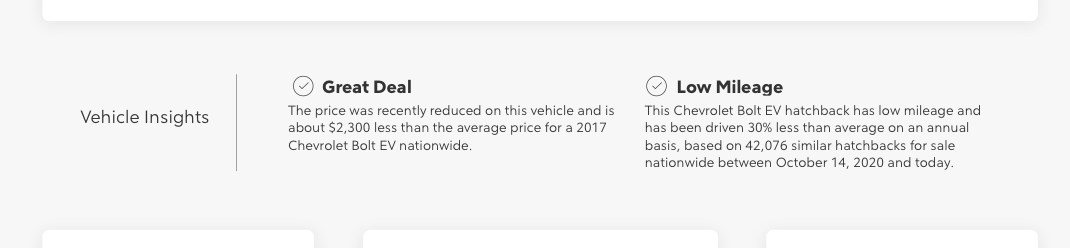
We planned for what buyers would see as they scrolled or when a listing had less information. On desktop, the photo got smaller so the vehicle name, price, estimated payment, and actions stayed visible. The insights panel adjusted to show one to five signals, or moved aside when there were none. On mobile, eight sections gave buyers a clear path through the details.

The vehicle-details design brings the information for evaluating a vehicle into one continuous page. The complete interface includes related vehicles and service information below.
The full vehicle page brings price, condition, and delivery together so buyers can weigh them in one place.
The mobile vehicle-details specification organizes the buying decision into eight sections.
The mobile layout guides buyers from the first photo through each detail they need before they decide what to do next.
The scrolled header retains vehicle identity and actions as the buyer moves through the details.
Sticky header keeps the vehicle, estimated payment, and actions in view.

The layout adapts to the information available

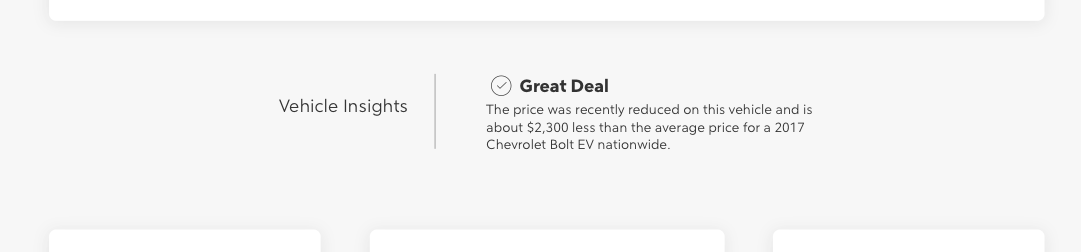
1 insight

A single-insight state keeps the information centered.
Even with just one insight, it still stands out. The layout adjusts but stays clear.

2 insights

A two-insight state adjusts the width of each signal.
With two insights, the row is filled, and buyers can focus on the most important details in the listing.

3 insights

The Vehicle Insights module presents price, condition, and ownership signals together.
With three insights, buyers can view price, condition, and ownership history at once. Each helps them decide.

5 insights

A five-insight variation extends the same vehicle evaluation structure.
With five insights, buyers get expanded context. The structure stays consistent, even as we add more information.
06

Build operational excellence by being consistent.

We focused on making our guidance useful by curating content. The team established taxonomy, voice, and formats for shopping guidance, along with clear CMS requirements. The plan covered ongoing creation, maintenance, and review. It identified governance, compliance, and measurement as areas to develop.

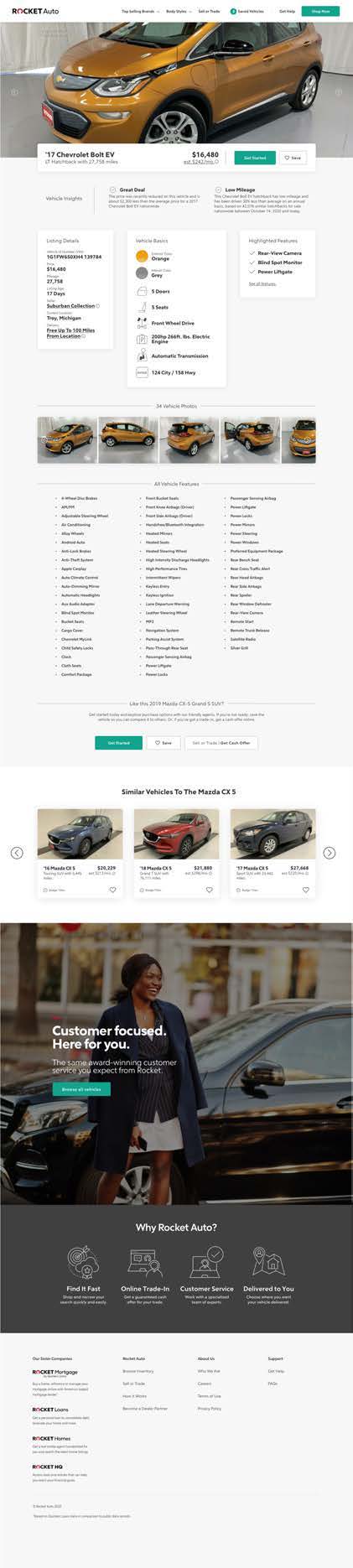
An alternate vehicle page adjusts the same structure to different vehicle content.
A different vehicle page uses the same layout but adapts to new vehicle content.
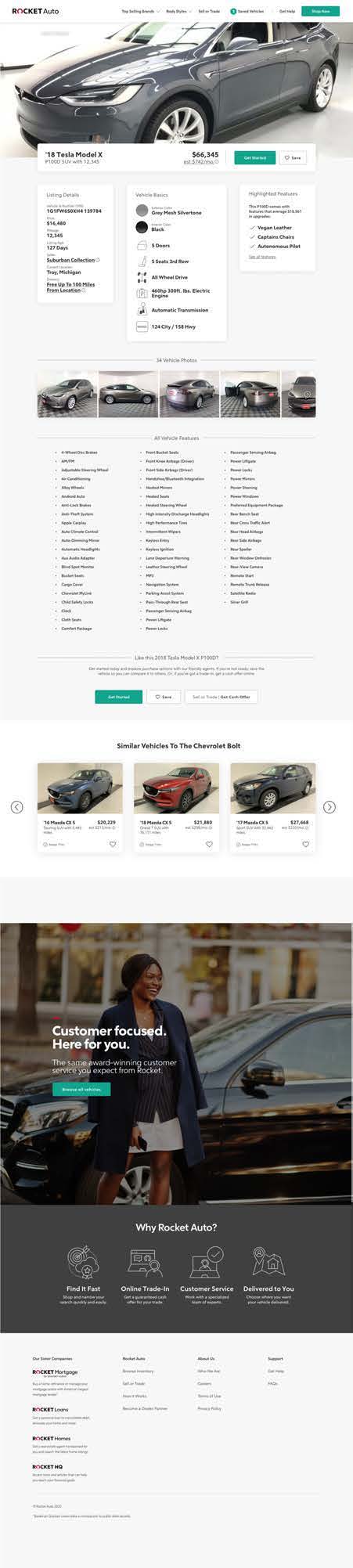
A further vehicle example tests the structure against a different mix of features.
Another vehicle example checks how the structure works with a different set of features.
07

Strategy that helps a team move forward

Rocket Auto launched its public marketplace in August 2021, offering over 35,000 used vehicles from more than 300 dealers nationwide. Buyers could browse, save, and compare vehicles, and get help from a Rocket Auto advisor. By November, Rocket had nearly 400 inventory partners on the marketplace. We began in California and Texas, which together made up about one in five U.S. car registrations in 2017. Our rollout plan gathered early feedback and shaped recommendations for the next markets to target.

Rocket’s existing mortgage relationship gave us a starting point. To earn the next sale, we made comparisons easy, clarified costs, and gave agents a way to keep the conversation going with buyers.

Credits

JT Anderson
Product and engagement strategy lead, executive direction and cross-team coordination
Taj Makki
Shopper research and product strategy collaboration
Taj Makki and Jenny Lee
Agent research
Todd Ridley
Rocket Auto design lead
Rocket Auto Product and Design, Spark Engineering, and platform partners
Design and delivery collaboration

Project visual